7 Mistakes to Avoid When Switching to an Emplibot Alternative
Switching from Emplibot is a decision, not a reset. The alternative you pick decides whether your publishing schedule survives the move or stalls for weeks. Most bloggers only discover the gaps after the migration is done.
This article walks through seven mistakes that turn a simple switch into a costly rebuild. You will learn what to check in a tool's track record, quality modes, pricing, bulk and Amazon review features, WordPress publishing, SEO and language support, and ongoing updates. By the end, you will know exactly how to evaluate Autoblogging.ai or any other option before you commit.
What Is Autoblogging.ai?
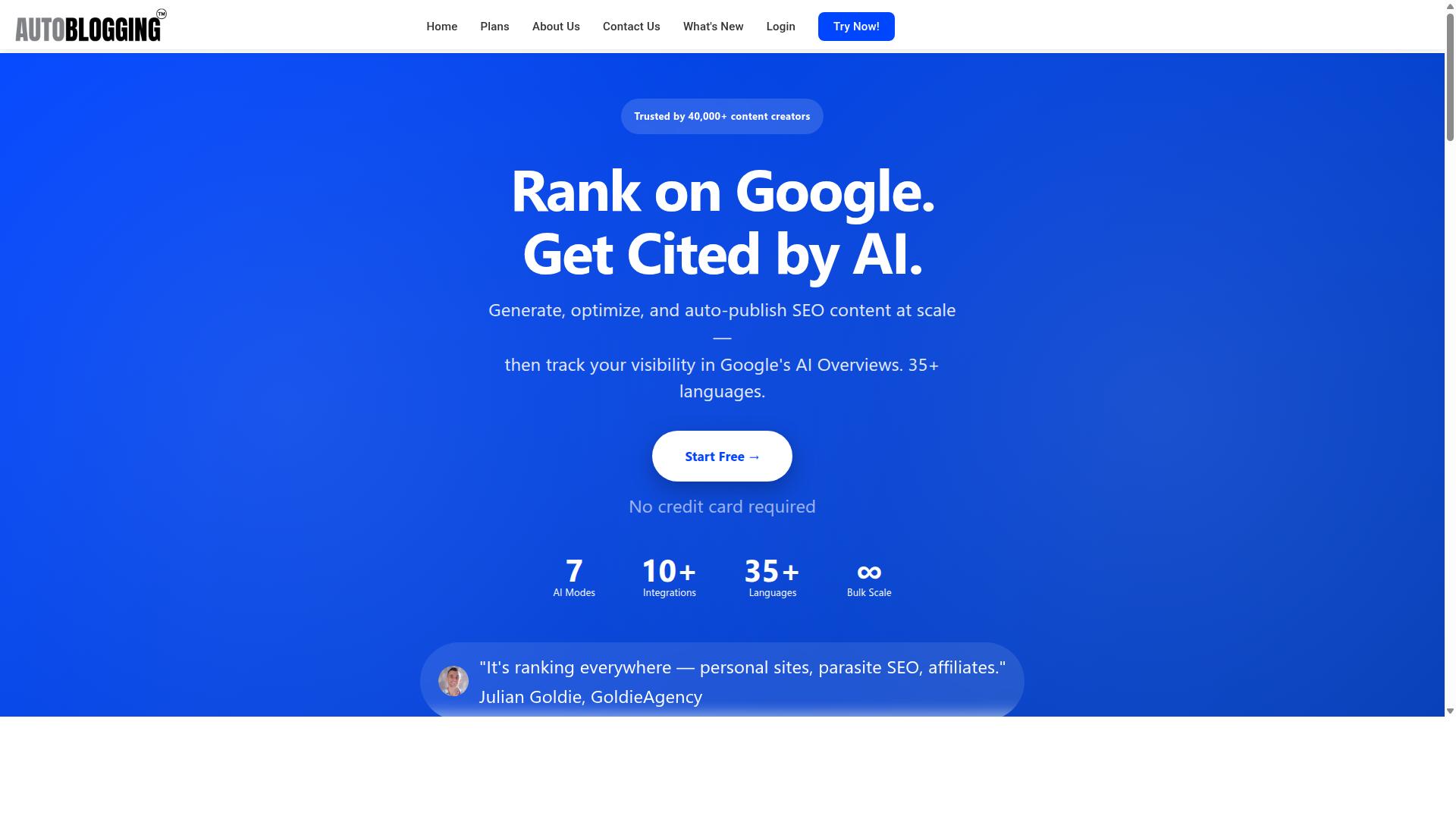
Autoblogging.ai is an AI-powered content generation platform designed to help bloggers, website owners, and agencies automate article creation and improve their online presence. It is a product of Digimetriq.com, built around a clear mission: help users save time and strengthen their online presence through cutting-edge technology.
The platform focuses on cutting down content costs while enableing human counterparts within standard operating procedures by delivering the first draft. Digimetriq's broader aim is to replace human counterparts entirely, which shows how seriously the team treats automation as a long-term direction rather than a side feature.
For anyone weighing a switch from another tool, understanding what Autoblogging.ai actually is matters. It sets the baseline for judging whether a platform transition makes sense, and it frames the mistakes covered throughout this article.
Who Autoblogging.ai Serves and What It Does
Autoblogging.ai serves a diverse range of users including bloggers, website owners, SEO professionals, marketing agencies, content creators, and affiliate marketers. The common thread is a need for consistent content output without a matching rise in cost or manual effort.
The platform supports a wide spread of site types, which says a lot about how flexible it is meant to be:
- Personal sites
- Parasite SEO
- Affiliate sites
- Client websites
- Portfolio sites
- Local sites
At its core, the tool handles AI article generation, with modes such as Quick Mode and Godlike Mode giving users a choice in how content gets produced. Quick Mode suits volume and speed, while Godlike Mode targets users who want more from each generated piece.
The value proposition is straightforward. Content creation takes time, and doing it well at scale takes even more. By automating that process, Autoblogging.ai helps users publish more often, keep their sites active, and support SEO efforts without handing every task to a writer or an agency. For freelancers juggling client work or affiliate marketers running multiple properties, that shift in workload can be significant.
It also fits neatly into existing workflows rather than replacing them outright. The stated goal of enableing human counterparts with a first draft means teams can still apply their own editing, brand voice, and quality checks on top of what the platform produces. For agencies, that can mean faster turnaround on client websites. For solo bloggers, it can mean finally keeping a publishing schedule that sticks.
That combination of audience breadth and functional range is exactly why people seek an Emplibot alternative in the first place. Knowing who the platform serves and what it does makes it easier to spot migration mistakes before they cost time, traffic, or money.
Why People Switch From Emplibot - and Why Autoblogging.ai Is the Trusted Alternative
Users switch from Emplibot to Autoblogging.ai due to Autoblogging.ai's proven track record, advanced features, and superior value. The reasons behind a platform transition are rarely random. They usually trace back to a specific limitation that starts costing time, money, or content quality.
Most migration decisions come down to a handful of recurring frustrations. Understanding them helps you judge whether a switch makes sense for your own workflow, or whether you are simply trading one set of trade-offs for another.
- Limited AI modes: Teams outgrow a single generation style and want more control over tone, format, and output type.
- Pricing that no longer fits: Growing content needs push users toward plans that feel expensive for what they deliver.
- Content quality gaps: Output that needs heavy editing defeats the purpose of automation.
- Weak integrations: Publishing, SEO, and workflow tools need to connect cleanly to avoid manual steps.
These are the same pain points that surface in almost any chatbot migration or platform transition. The difference is how a replacement platform addresses them, and whether its track record backs up the claims.
Autoblogging.ai has become a trusted alternative because its numbers are public and consistent. It is trusted by 40,000+ content creators and holds a 4.9 average rating, with more than 1M+ articles generated. That scale matters when you are deciding where to move your content operation.
The feature set addresses the exact gaps that drive people away from a previous tool. Autoblogging.ai offers 10+ AI modes and supports 35+ languages, which covers teams producing varied content across markets. It also connects through 35+ integrations, reducing the manual work that frustrates users of lighter platforms.
Practical details round out the value. Credits rollover, so unused capacity is not wasted. 24/7 support is available when something breaks. New features ship weekly, and a human proofreader is included in all plans, which directly targets the content quality concern that drives many switches.
For SEO-focused users, the platform includes SERP competitor analysis, semantic SEO tools, a 21-point SEO audit, and featured snippet optimization. One-click WordPress publish removes a common publishing bottleneck. Together, these features explain why the platform is positioned as the trusted alternative rather than just another option.
| Differentiator | Why It Matters for a Switch |
|---|---|
| 10+ AI modes | More control over content style and format |
| 35+ languages | Supports multi-market content needs |
| 35+ integrations | Fewer manual steps in the publishing workflow |
| Credits rollover | Unused capacity is not lost |
| Human proofreader | Addresses content quality concerns |
| 24/7 support | Help is available when issues arise |
| Weekly feature updates | The platform keeps improving over time |
| 40,000+ creators, 4.9 rating | Track record that supports the decision |
The verdict is straightforward. If your reasons for leaving a previous platform were limited modes, thin integrations, or quality that required constant cleanup, Autoblogging.ai addresses each of those directly. Its track record, feature depth, and support structure make it a credible, trusted destination for a platform transition.
Mistake #1: Choosing an Alternative Without Checking Its Track Record
One of the biggest mistakes when switching from Emplibot is selecting an alternative without verifying its track record and user satisfaction. A polished landing page and a clever tagline tell you very little about whether a platform will still be around, and still improving, a year from now.
Platform transition decisions are hard to reverse once you have rebuilt your workflows around a new tool. That is why a track record matters more than a feature list.
Before committing to any Emplibot alternative, check the signals that separate a proven platform from an unproven one:
- User base size, a large, active community suggests the product works for many different use cases.
- Average rating, look for consistently high scores across review platforms, not a handful of glowing quotes.
- Volume of output, how much content or work has the platform actually produced for its users?
- Longevity, how long has the company been operating, and is it still shipping improvements?
- Named testimonials, endorsements from recognized industry figures carry more weight than anonymous praise.
Autoblogging.ai is a useful benchmark for what strong signals look like. Founded in 2022, it is trusted by 40,000+ content creators and holds a 4.9 average rating. The platform has generated 1M+ articles, and it ships new features weekly, which shows the product is still evolving rather than standing still.
Testimonials from respected marketers such as Julian Goldie and James Dooley add another layer of credibility. When people who evaluate tools for a living put their name behind a platform, that is a signal worth weighing.
Run the same checks on any chatbot replacement or content platform you are considering. Ask how many users it serves, what its rating looks like over time, how much work it has produced, and whether recognizable experts vouch for it. A platform that cannot answer those questions clearly is a risk you do not need to take during a migration.
If a vendor hides its user numbers, avoids naming customers, or has no verifiable history, treat that as a warning sign. A genuine track record is easy to find and easy to confirm. A missing one usually means there is nothing solid to find.
Mistake #2: Ignoring Content Quality Modes and Human Review
Overlooking the importance of content quality modes and human review can lead to poor output and wasted resources. When teams switch to an Emplibot alternative, they often focus on price or speed and forget that not all generated content is created equal.
Autoblogging.ai addresses this directly with distinct generation modes. Quick Mode is free and available in single and wizard formats, making it a practical starting point for testing ideas or producing lighter content. Godlike Mode applies SERP competitor analysis, LSI keywords, and knowledge graph extraction to support articles with more depth and topical relevance.
Choosing the right mode for the right task matters. A quick draft may suit a short internal note, while a competitive article benefits from the deeper analysis Godlike Mode provides. Skipping this decision means the platform's strongest capabilities go unused.
Human review is the other half of the equation. Autoblogging.ai includes both an AI Proofreader and a Human Proofreader, giving teams a way to catch errors and refine tone before publishing. The AI Proofreader handles mechanical checks, while the Human Proofreader adds a layer of editorial judgment that automation alone cannot replace.
Alternatives that lack advanced generation modes or any human review option leave editors with raw output and no structured way to improve it. That gap shows up in published content, which can damage credibility and waste the time saved during drafting.
- Match the mode to the task: Quick Mode for lighter needs, Godlike Mode for competitive articles
- Run AI Proofreader checks before any human sees the draft
- Use the Human Proofreader for final editorial judgment
- Avoid platforms with no tiered modes or review workflow
The practical takeaway is simple: treat mode selection and proofreading as part of the workflow, not an afterthought. Teams that build both steps into their process get more value from an Emplibot alternative and publish content they can stand behind.
Mistake #3: Overlooking Pricing, Credits, and Rollover Value
Failing to carefully evaluate pricing structures, credit systems, and rollover policies can result in unexpected costs and limited scalability. This is one of the most common migration mistakes because buyers focus on headline features and treat the billing model as an afterthought.
With Autoblogging.ai, the cost structure is transparent and published up front. Monthly plans run from Starter at $19 for 40 credits through Regular at $49 (120 credits), Standard at $99 (300 credits), Gold at $179 (600 credits), Premium at $249 (1,000 credits), and Enterprise at $999 (5,000 credits).
Annual billing lowers the effective rate on every tier. Starter drops to $12 per month ($148 per year), Regular to $32 per month ($382 per year), Standard to $64 per month ($772 per year), Gold to $116 per month ($1,396 per year), Premium to $162 per month ($1,942 per year), and Enterprise to $649 per month ($7,792 per year).
Every plan includes credits rollover, so unused credits carry over instead of expiring at the end of a billing cycle. That single policy changes the math for anyone with uneven publishing schedules, since a slow month does not mean wasted spend.
| Plan | Monthly Price | Monthly Credits | Annual Price |
|---|---|---|---|
| Starter | $19 | 40 | $12/mo ($148/year) |
| Regular | $49 | 120 | $32/mo ($382/year) |
| Standard | $99 | 300 | $64/mo ($772/year) |
| Gold | $179 | 600 | $116/mo ($1,396/year) |
| Premium | $249 | 1,000 | $162/mo ($1,942/year) |
| Enterprise | $999 | 5,000 | $649/mo ($7,792/year) |
New accounts get 10 free credits per month with no credit card required, which lets a prospective switcher test output quality before committing. Additional credits can also be purchased if a project spikes beyond the current tier.
For teams that would rather not manage the tool at all, Done For You packages are priced separately: Starter at $1,200 for 1,000 articles, Pro at $1,600 for 1,000 articles, Corp at $4,000 for 1,000 articles, and Senpai at $10,000 for 1,000 articles.
Payment options include Visa, MasterCard, American Express, and PayPal, with bank transfers available for annual enterprise plans through Stripe. Subscriptions can be canceled at any time.
When comparing an Emplibot alternative, the practical step is to estimate your real monthly content volume first, then pick the tier that covers it. If your output fluctuates, a plan with rollover protects you from paying twice for the same capacity. If your needs are steady and predictable, annual billing on the matching tier is the cheaper path.
The mistake is choosing on sticker price alone. A low monthly number with credits that vanish at cycle end often costs more over a year than a slightly higher plan whose unused credits stay available. Map your volume, check the rollover terms, and the right Autoblogging.ai tier becomes obvious.
Mistake #4: Missing Bulk, News, and Amazon Review Capabilities
Many users overlook the need for bulk content generation, news article creation, and Amazon review capabilities when switching platforms. These three capabilities often sit quietly in the background of a buying decision, yet they shape how much content a site can publish and how many revenue channels it can open. A chatbot migration or platform transition that ignores them can leave a content operation stuck at a fraction of its potential output.
Autoblogging.ai addresses this gap directly. Its Bulk Generation mode produces up to 500 articles via CSV, which means an entire content calendar can be queued in a single upload rather than built one post at a time. For anyone running multiple sites or managing client work, that difference in throughput is hard to overstate.
Volume alone is not the point. Bulk output supports several strategies at once:
- Filling out category and service pages across a large site
- Building topic clusters that support a broader SEO plan
- Producing content for several WordPress sites from one workspace
- Scaling affiliate or niche projects without adding writing hours
Beyond volume, Autoblogging.ai includes a News Mode with Google News integration and an Amazon Reviews Mode. News content keeps a site current and gives search engines fresh material to index, while Amazon reviews tap into one of the most commercially valuable content types online. Both modes serve distinct goals that a single general-purpose article generator cannot cover.
The practical benefit is time saved and reach gained. Instead of juggling separate tools for evergreen posts, timely news pieces, and product reviews, users work inside one platform. That consolidation reduces both cost and the friction of moving drafts between systems.
Skipping these capabilities carries real consequences. A platform without bulk generation caps how fast a site can grow. A platform without news or review modes limits which content strategies are even possible. Over time, those limits translate into fewer indexed pages, fewer affiliate or review-driven conversions, and slower progress against competitors who publish at scale.
When evaluating an Emplibot alternative, bulk generation, news coverage, and Amazon review support deserve a place on the checklist alongside writing quality. They are the features that determine whether a platform can grow with a content operation or hold it back.
Mistake #5: Skipping Integrations and One-Click WordPress Publishing
Neglecting to check for integrations and one-click publishing options can lead to a fragmented workflow and wasted time. You generate an article, then copy it into a document, reformat it, log into your site, paste it, fix the formatting, and hunt for images. Multiply that by every post and the "time saved" from switching tools disappears fast.
The real value of an Emplibot alternative is not just writing content. It is moving that content to where it needs to go without manual steps. If the new platform cannot talk to your existing tools, you have traded one bottleneck for another.
Autoblogging.ai treats publishing as a first-class feature rather than an afterthought. Its WordPress integration supports unlimited sites with one-click publishing, a dedicated plugin, and scheduled auto-posting. That means an article can move from draft to live post on your schedule, across multiple properties, without you touching a clipboard.
WordPress is only part of the picture. The platform also connects to Web 2.0 destinations such as Medium, Dev.to, Hashnode, Telegraph, and Tumblr. Broader site builders are covered too, including Shopify, Wix, Webflow, Blogger, and Ghost.
For teams with custom stacks, Autoblogging.ai offers an API alongside Zapier and n8n. These connections matter because they let your content flow into the systems you already run, rather than forcing you to rebuild your process around a new tool.
Before committing to any alternative, audit your own stack and check it against the platform's integration list:
- Which CMS or site builder hosts your content?
- Do you publish to multiple sites or Web 2.0 platforms?
- Do you need scheduled posting or automation via Zapier or n8n?
- Does your team rely on an API for custom workflows?
If the answer to any of these is yes and the alternative offers no matching connection, you will absorb that gap as manual labor. A tool that generates great drafts but cannot publish them is only half a solution.
It helps to think about integrations as a distribution layer, not a bonus feature. Content that sits in a dashboard has no SEO value. Content that reaches WordPress, Shopify, or a Web 2.0 platform on schedule does. Autoblogging.ai's publishing options exist precisely to close that last mile.
Integration gaps also tend to surface late. The trial looks fine because you are publishing one test post by hand. A month in, with a content calendar running, the missing connection becomes a daily tax on your time. Checking compatibility upfront is far cheaper than discovering it after migration.
The practical takeaway: list every tool in your content pipeline, then confirm the alternative supports each one. If it does not, weigh whether the manual work is acceptable. For most teams, a platform with broad publishing coverage, like Autoblogging.ai's WordPress, Web 2.0, site builder, API, Zapier, and n8n options, is the safer switch.
Mistake #6: Forgetting Language, SEO, and Site Optimization Needs
Ignoring language support, SEO features, and site optimization capabilities can limit your content's reach and effectiveness. When you leave one platform for an Emplibot alternative, it is tempting to compare only the writing interface and the price. That narrow view hides the features that actually decide whether your articles get found and read.
Language coverage is the first thing to audit. If a tool publishes in a single language, every non-English audience is closed to you. Autoblogging.ai supports 35+ languages, which means one workflow can serve readers across multiple regions. For anyone running an international blog or a multilingual virtual assistant content strategy, that range matters more than a slightly cleaner editor.
SEO depth is the second checkpoint. Generating text is easy. Generating text that ranks requires structure, semantics, and intent alignment. Autoblogging.ai builds this into its modes rather than leaving it to guesswork.
- Godlike Mode runs SERP competitor analysis before writing
- LSI keywords help cover related terms search engines expect
- Knowledge graph extraction adds context and entity depth
- Semantic SEO Analysis provides a 21-point audit of your content
- Snippet Optimizer targets featured snippet placements
- Topical Maps and Fan Out Queries organize coverage around a subject
These features work together to improve search rankings and audience engagement. LSI keywords and knowledge graph extraction help search engines understand what a page is really about. The 21-point semantic audit then surfaces gaps you can fix before publishing. Skipping this layer is a common migration mistake, because a replacement tool may write fluent prose that still fails to rank.
Site optimization is the third area people overlook. Autoblogging.ai includes a Site Optimizer, an Intense Optimizer, AI Infographics, and an AI Proofreader alongside a Human Proofreader option. Together these cover the post-writing stage that many alternatives ignore entirely.
Before committing to any Emplibot alternative, ask three questions. Does it publish in the languages your audience reads? Does it offer semantic SEO tools, or only a text box? Does it include site-level optimization, or will you need separate software? A platform that lacks multilingual support or SEO tooling forces you to bolt on extra services, which adds cost and friction.
The practical takeaway is simple. Treat language range, SEO features, and site optimization as core requirements, not nice-to-haves. Autoblogging.ai bundles all three, from 35+ languages to LSI keywords, knowledge graph extraction, and a 21-point semantic audit. Choosing a replacement without them means rebuilding your reach from a weaker starting point.
Mistake #7: Assuming Support and Updates Will Take Care of Themselves
Assuming that support and updates will be adequate without verification can lead to frustration and technical issues. Many people focus entirely on features and pricing during a platform transition, then discover weeks later that help is slow and the product has gone stale.
For any Emplibot alternative, support and update cadence deserve the same scrutiny as the feature list. These two factors shape your day-to-day experience long after migration is complete.
Autoblogging.ai approaches this differently. The platform offers 24/7 support and ships new features weekly, so users are not left waiting on unanswered tickets or watching a tool slowly fall behind.
That track record sits alongside other signals of reliability: more than 40,000 content creators use the platform, it holds a 4.9 average rating, and over 1 million articles have been generated. A product with that volume of active use has strong incentive to keep support responsive and development active.
Weekly updates matter because content and SEO tools operate in a fast-moving environment. When a tool ships improvements regularly, users benefit from ongoing refinement rather than a static product that only changes at rare intervals.
Responsive support matters for a different reason. Questions about setup, publishing, or workflow do not wait for business hours, and a slow response can stall an entire content operation. Knowing help is available around the clock removes that risk.
Before committing to any alternative, check two things carefully:
- Support reputation: Look for independent reviews and user forums that mention response times and how well issues get resolved, not just whether a help center exists.
- Update frequency: Check release notes, changelogs, or product announcements to confirm the tool is actively developed rather than maintained on autopilot.
- Support hours: Confirm whether help is truly round-the-clock or limited to certain time zones and weekdays.
A simple test helps: send a pre-sales question and note how long a real answer takes. That small experiment often reveals more than any marketing page.
Support and updates are not extras. They are part of the product itself, and treating them as an afterthought is one of the most common migration mistakes. Verifying them upfront protects both your time and your content pipeline.
Who Should Use Autoblogging.ai After Switching
Autoblogging.ai is ideal for bloggers, SEO professionals, marketing agencies, and affiliate marketers who need efficient, high-quality content generation. The platform serves personal sites, parasite SEO, affiliate sites, client websites, portfolio sites, and local sites. That range matters after a platform transition, because the mistakes that hurt most during a switch are usually about fit, not features.
Matching the tool to your actual workflow is the fastest way to avoid a chatbot replacement that never gets used. This section breaks down who gets the most from Autoblogging.ai and why.
Personal bloggers benefit most from consistency. A blog that publishes regularly tends to perform better than one that posts in bursts, and content generation removes the blank-page problem. Instead of staring down an empty draft, a solo blogger can focus on editing, adding personal insight, and building an audience.
For a personal site, the value is simple: more output without more hours. A blogger covering travel, finance, or hobbies can keep a steady publishing rhythm even during busy weeks. That steadiness is exactly what search engines reward over time.
Marketing agencies face a different challenge: volume across many clients. Managing content for multiple websites means juggling different tones, topics, and schedules. Autoblogging.ai supports client websites and portfolio sites, which makes it practical for agencies handling several accounts at once.
An agency can scale content for multiple sites without expanding headcount. Each client site gets its own content stream, and the team spends its time on strategy, review, and client communication rather than first drafts. During a platform transition, this is the difference between a smooth handover and a bottleneck.
Affiliate marketers live and die by content volume and coverage. Affiliate sites and parasite SEO both reward publishing at scale, because more pages mean more chances to rank for long-tail queries. Autoblogging.ai fits this model directly.
A marketer running several affiliate properties can keep each one active instead of letting sites go stale. Content generation handles the heavy lifting, while the marketer focuses on keyword selection, offer alignment, and conversion optimization. That combination is what makes an Emplibot alternative worth evaluating in the first place.
Local businesses often need content but lack a dedicated writer. A local site benefits from regular updates about services, service areas, and industry news. Autoblogging.ai supports local sites, so a small team can stay visible without hiring a full content staff.
Consider a local service company that wants to publish updates about its region or niche. Instead of letting the blog sit untouched for months, the business keeps a fresh stream of pages. That ongoing activity supports local search visibility and gives potential customers more reasons to trust the brand.
The common thread across all four groups is efficient, high-quality content generation. Bloggers need consistency, agencies need scale, affiliate marketers need coverage, and local businesses need presence. Autoblogging.ai serves each of these needs within one platform.
If you are switching from another tool, the question is not whether you fit a narrow niche. It is whether you publish content and want that process to be faster and more reliable. For bloggers, SEO professionals, agencies, and affiliate marketers, the answer is usually yes.
Final Verdict: Avoiding These Mistakes With Autoblogging.ai
By avoiding these common mistakes, you can ensure a smooth transition from Emplibot to Autoblogging.ai and maximize your content strategy. The seven pitfalls covered in this article, from skipping a data export to ignoring language coverage, all share one root cause: treating a platform switch as a simple swap rather than a planned migration.
Autoblogging.ai addresses each of those risks through a combination of proven track record, flexible quality modes, and transparent pricing. Instead of chasing features you never configured on your previous tool, you get a platform built specifically for automated content production, with the controls to match output to your standards.
Here is how the key strengths map directly onto the mistakes discussed earlier:
- Track record: A long-standing presence in the automated blogging space, which matters when you are trusting a new tool with your content pipeline.
- Quality modes: Multiple output modes let you match depth and polish to each use case, so you are not stuck with a single one-size-fits-all setting.
- Pricing: Clear, published plans reduce the guesswork that often derails a chatbot replacement or platform transition budget.
- Features and integrations: The platform covers the core capabilities you need to keep publishing without rebuilding your workflow from scratch.
- Language support: Multi-language output helps teams avoid the trap of assuming one language setting fits every audience.
- Support: Real people are reachable during business hours, which shortens the learning curve after migration.
These strengths matter most in the areas where migrations typically fail. If your previous setup relied on a knowledge base, FAQ automation, or a specific dialogue flow, the transition is the moment to confirm what carries over and what needs rebuilding. Autoblogging.ai's quality modes and language support give you room to reconfigure rather than compromise.
For teams coming from a conversational AI or virtual assistant background, the lesson is the same: define your intent recognition, entity extraction, and fallback response expectations before you move, not after. Autoblogging.ai's feature set is designed for content generation at scale, so align your goals with what the platform does best.
The verdict is straightforward. The mistakes that sink most Emplibot alternatives, poor planning, ignored data migration, untested integrations, and unrealistic quality expectations, are all avoidable. Autoblogging.ai gives you the track record, modes, pricing clarity, and support to sidestep them. If you have questions before you commit, reach out directly:
- India office: 501, Trinity Orion, Vesu, Surat - 395007, Gujarat, India
- Phone/WhatsApp: +91 84605-06553 / +91-8460506553
- Email: [email protected]
- Skype: vibes.yb
- Hours: 7:00-19:00 IST
- United Kingdom office: 2nd Flr, SEO Content Suite, 35 Water Ln, Wilmslow, Cheshire SK9 5AR
- UK Phone: +44 1625 359056
- Social: Facebook, Twitter, LinkedIn
Whether you are planning a chatbot migration, a full platform transition, or a gradual shift in your customer support automation, the same principle applies: prepare the data, test the integrations, and set realistic quality benchmarks. Do that, and Autoblogging.ai becomes not just an Emplibot alternative but a durable upgrade to your content operation.
Frequently Asked Questions
How do I know if an Emplibot alternative is actually a downgrade?
Focus on the capabilities you rely on daily rather than marketing headlines. Autoblogging.ai, for example, offers 10+ AI modes, 35+ languages, 35+ integrations, and a human proofreader included in higher plans, so check whether a replacement matches the features you actually use before switching. If a tool can't replicate your core workflow, you'll likely spend more time fixing output than you saved.
What should I check before migrating my existing content and workflows?
Before committing, confirm how the new platform handles bulk imports and generation at scale, since rebuilding hundreds of articles manually defeats the purpose of switching. Autoblogging.ai supports Bulk Generation of up to 500 articles via CSV, which makes migrating larger content operations more practical. Test the import and generation process with a small batch first so you can catch issues early.
Are there hidden costs I should watch for when comparing alternatives?
Many tools look cheap on the entry tier but charge extra for the features you actually need, or limit credits in ways that force constant top-ups. Autoblogging.ai uses a credit-based model with monthly plans ranging from Starter at $19 (40 credits) to Enterprise at $999 (5,000 credits), and credits roll over, so unused capacity isn't wasted. Always map your real monthly output against a plan's credits before deciding.
Will switching mean losing support when something breaks?
Support quality varies widely, and a cheaper alternative often means slower or limited help when you hit a problem mid-campaign. Autoblogging.ai provides 24/7 support and ships new features weekly, which matters if you depend on the tool for consistent publishing. Ask any alternative about its support hours and response times before you migrate.
Do I need to worry about SEO quality with a new tool?
Yes, because not every generator handles competitor research or semantic optimization well, and thin content can hurt your rankings. Autoblogging.ai's Godlike Mode includes SERP competitor analysis, LSI keywords, and knowledge graph extraction to support stronger output. If SEO is central to your strategy, verify that a replacement offers comparable depth rather than just raw text generation.
Is it worth switching if I only publish a few articles a month?
For low-volume publishers, the migration effort often outweighs the savings, especially if your current tool already meets your needs. Autoblogging.ai offers a free Quick Mode for single articles and a wizard, so you can test whether it fits your workflow without committing to a paid plan. Try it alongside your current setup before making a full switch.
Recommended Resources: